

Electrical
All About EVs and Charging at Home: What You Need to Know Before You Plug In
Home EV charging explained: Level 1 vs Level 2, whether your panel can handle it, how to check your service size, Tesla Wall Connectors, and what installation involves.
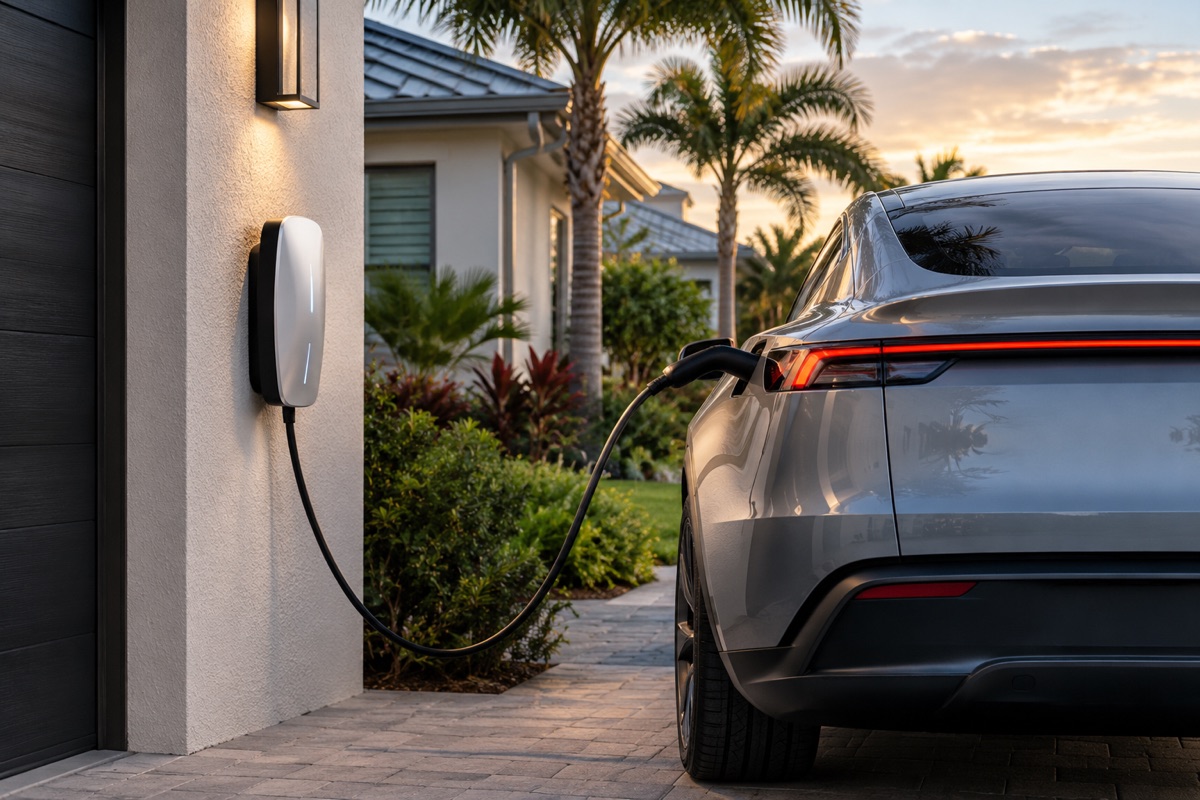
Ask most electric vehicle owners what they love most about their car, and you’ll hear about the quiet ride, the instant acceleration, or never stopping for gas again. But the answer that comes up again and again is simpler: waking up every morning to a full “tank.”
Home charging is what makes EV ownership truly convenient. This guide covers how home charging works, what your house needs to support it, how to check your electrical panel yourself, and what goes into a professional installation.
Why Charge at Home?
Most EV owners do the vast majority of their charging at home, and once you’ve done it for a week, it’s easy to see why.
- Your car charges while you sleep. Plug in when you get home, and it’s ready in the morning. No detours, no waiting at a station.
- You start every day with the range you need. Most daily driving around Jacksonville, from a commute down I-95 to errands in Mandarin or a trip to the Beaches, uses only a fraction of a typical EV’s range.
- It’s usually the least expensive way to charge. Home electricity typically costs far less per mile than gasoline, and less than most public fast chargers.
- It’s easier on your battery. Steady overnight Level 2 charging is gentler on your battery than relying on DC fast charging every day.
- Public chargers become a road-trip tool, not something you depend on every week.
What Does It Cost to Charge?
Most EVs travel roughly 3 to 4 miles per kilowatt-hour (kWh). That means 1,000 miles of driving uses about 250 to 330 kWh of electricity. Multiply that by the rate on your JEA bill, and for most drivers the monthly cost of “fuel” is a fraction of what they used to spend at the pump.
The Three Levels of EV Charging
| Level 1 | Level 2 | DC Fast Charging | |
|---|---|---|---|
| Power source | Standard 120V outlet | 240V dedicated circuit | Commercial high-voltage equipment |
| Where you find it | Any household outlet | Homes, workplaces, hotels | Highway corridors, Superchargers |
| Typical range added per hour | About 3–5 miles | About 20–45 miles | Hundreds of miles per hour |
| Best for | Light driving, plug-in hybrids, backup | Everyday home charging | Road trips |
Level 1 uses the cord that often comes with the car and a regular outlet. It works, but adding only a few miles per hour means a fully depleted battery can take days to refill. It’s fine as a backup or for very light driving, but most owners outgrow it quickly.
Level 2 is what most people mean by a “home charger.” It uses a dedicated 240-volt circuit, similar to what powers your dryer or AC, and can fully recharge most EVs overnight. This is what we recommend for nearly every EV owner.
DC fast charging is what you’ll find along the interstate. It isn’t practical or available for homes, but it’s great for road trips.
What Your Home Needs for a Level 2 Charger
A Level 2 charger is one of the largest electrical loads you can add to a home, comparable to a central air conditioner. Before installing one, we look at three things.
1. Enough Electrical Service: 200 Amps Recommended
Your home’s electrical service is the total amount of power available to the house, measured in amps. Most modern homes have 200-amp service, while many older homes have 100 or 150 amps.
We recommend 200-amp service for a full-power home EV charger. Here’s why: a full-power Level 2 charger typically draws about 48 amps continuously for hours at a time, on a 60-amp circuit. In a Jacksonville home, that charger may be running at the same time as your AC, water heater, dryer, oven, and pool pump. A 200-amp service generally has room for all of that.
Have 100 or 150 amps? You still have options:
- Load calculation: We calculate your home’s actual demand. Some homes with smaller service still have enough capacity.
- Lower charging speed: Most chargers can be set to draw less power, for example 24 or 32 amps. That’s still plenty to fully charge overnight for most drivers.
- Load management: Smart devices can automatically reduce charging when the rest of the house is using a lot of power, then ramp back up when demand drops.
- Service upgrade: If you’re planning more electrical additions, such as a second EV, a pool, or a home addition, upgrading to 200 amps may be the best long-term move. We coordinate the upgrade with JEA.
2. Space in Your Panel for a New Breaker
Your charger needs its own dedicated circuit, which means a new double-pole breaker in your panel. A double-pole breaker takes up two side-by-side spaces. If your panel is full, there are solutions, such as consolidating circuits, using approved tandem breakers where the panel allows, or adding a subpanel. But a full panel is something we’ll want to know about up front.
3. A Path for the New Circuit
We run a new circuit from your panel to where the charger will be mounted. The distance, the route (through the garage, attic, or along the exterior), and the wall construction all affect the installation. Garages next to the panel are the easiest. Driveway installs and detached garages are very doable with a bit more planning.
How to Check Your Panel Yourself
You can get a good idea of where you stand in a couple of minutes, without removing any covers. Just open the panel door and look. (New to what’s inside the box? Our guide to panels and breakers walks through it.)
Step 1: Find your main breaker. The main breaker is the large breaker, usually at the top of the panel and often separated from the others. The number stamped on its handle, such as 100, 150, or 200, is your service size in amps.
Don’t see a main breaker inside? That’s common in Florida homes. Many houses have the main breaker outside, in a combination meter and panel or a separate disconnect next to the meter. Check there for the large breaker and its amp rating.
Step 2: Look for open spaces. Check for empty slots. These usually have removable “knockout” covers or blank fillers instead of breakers. You’ll need two empty spaces next to each other for an EV charger breaker.
Step 3: Check the label. The sticker on the inside of the panel door usually lists the panel’s brand, model, and maximum rating. A clear photo of it helps us a lot.
Step 4: Send us photos. Take a photo of the open panel (door open, cover on), the label, and your meter or outside disconnect. With those, we can often tell you during the first conversation whether you’re ready to go or need an upgrade.
Safety first: Look, but don’t touch. Never remove the panel’s inner cover. The parts behind it are live even when the main breaker is off.
Choosing Your Charger: Tesla Wall Connector or Universal Wall Connector
We install a range of Level 2 chargers, but two of the most popular options for Jacksonville homeowners come from Tesla.
Tesla Wall Connector
Tesla’s Wall Connector is a clean, compact unit with a NACS (Tesla-style) connector.
- Up to 48 amps of charging, adding up to roughly 40 miles of range per hour on many models
- Wi-Fi connected for updates and charging data in the app
- Rated for indoor and outdoor installation, which works well for driveways and carports
- Power sharing between multiple Wall Connectors if your household has more than one EV
Universal Wall Connector
The Universal Wall Connector is built for households that have, or might someday have, more than one brand of EV. It includes a NACS cable with a built-in adapter, so it can charge both NACS-equipped vehicles and those with the older J1772 port.
This matters because the EV industry is shifting. Many automakers are moving to the NACS connector, but plenty of vehicles on the road still use J1772. A Universal Wall Connector means you won’t have to replace your charger if your next car is a different brand.
Other Options
We also install other reputable Level 2 chargers. If you have a preferred brand, a specific car, or need features like detailed energy reporting, we’re happy to recommend options.
Hardwired vs. Plug-In
Some chargers plug into a 240-volt outlet (often called a NEMA 14-50). Others are hardwired directly to the circuit. We generally recommend hardwiring:
- It allows the full 48-amp charging rate.
- It eliminates the outlet, which is the most common failure point with high-power continuous loads.
- It avoids nuisance-tripping issues that can occur with GFCI-protected outlets and some chargers.
Plug-in setups still make sense in certain situations, such as when you might take the charger with you when you move. We’ll walk you through the trade-offs.
Your Charger or Ours, We Handle the Installation
Already bought a charger? No problem. We install customer-supplied Tesla Wall Connectors, Universal Wall Connectors, and other quality Level 2 chargers.
Rather have us take care of everything? We can supply the charger as part of a turnkey installation, so there’s one point of contact and nothing for you to coordinate.
Either way, our installation includes:
- Site assessment: We review your service size, panel space, and charger location, and perform a load calculation if needed.
- Permitting: We pull the required electrical permit.
- Circuit installation: We install the dedicated breaker and run properly sized wiring to the charger location.
- Charger mounting and connection: Your charger is mounted at a convenient height and position for your parking setup.
- Configuration: We set the charger’s amperage to match the circuit and help connect it to Wi-Fi and the app.
- Inspection: The work is inspected and signed off.
- Test charge: We make sure your car is charging properly before we leave.
We Wired the Tesla Service Center Right Here in Jacksonville
When Tesla built its service center at 11650 Abess Blvd in Jacksonville, Copper & Co. Services handled all of the electrical work.
A commercial EV service facility has demanding electrical requirements, from heavy power distribution to the infrastructure behind charging and servicing a steady flow of electric vehicles. We bring the same standards and attention to detail to every home charger installation, whether it’s a single Wall Connector in a Mandarin garage or a two-car setup with power sharing in Nocatee.
When you choose Copper & Co. for your home charger, you’re working with the electricians Tesla’s Jacksonville service center relied on.
Jacksonville-Specific Things to Consider
Heat in the garage. Jacksonville garages get hot in the summer. Quality Level 2 chargers are built to handle it, but proper wire sizing and solid connections matter even more when a circuit runs for hours in high heat. This is one reason we prefer hardwired installations.
Outdoor and carport installs. Many local homes park in driveways or under carports. Outdoor-rated chargers like the Tesla Wall Connector handle Florida’s rain and humidity well when they’re mounted and connected properly.
Storm season. Summer lightning and hurricane-season outages can send surges through your home. Your EV is one of the most valuable electrical devices you own. Whole-home surge protection at your panel is an inexpensive way to protect your charger and your car’s onboard charging equipment.
Your car as a backup power source. Some newer EVs and trucks can power parts of a home during an outage. This requires specific equipment and proper transfer switching to do safely. If that’s on your wish list, let us know when we plan your installation.
Ready to Charge at Home?
Whether you’ve just ordered your first EV or you’re tired of relying on public chargers, home charging is one of the best upgrades you can make.
This article is for general information. Charging speeds vary by vehicle and charger. Electrical requirements depend on your home’s existing service and local code. Always use a licensed electrician for EV charger installation.
Frequently asked questions
Do I need 200-amp service to install an EV charger?
Not always. We recommend it for full-power charging, but many homes with 100- or 150-amp service can support a charger with a load calculation, a lower charging rate, or load management.
How long does installation take?
Most straightforward installations are completed in a single day. Service upgrades or long circuit runs take longer and include coordination with JEA.
Can I install a Tesla charger if I don't drive a Tesla?
Yes. The Universal Wall Connector supports both NACS and J1772 vehicles, and many newer non-Tesla EVs use the NACS connector.
Is Level 1 charging enough?
For a plug-in hybrid or very light driving, it can be. For most full-electric drivers, Level 2 is far more practical.
Can I install the charger outside?
Yes. Many chargers, including the Tesla Wall Connector, are rated for outdoor installation.
What if I have two EVs?
We can install two chargers with power sharing, which splits available power between them automatically. You often don't need two full-size circuits.
Do I need a permit?
Yes. A new EV charging circuit requires an electrical permit and inspection. We handle both.