

Electrical
All About Panels and Breakers: A Jacksonville Homeowner's Guide
Standard, GFCI, AFCI, and smart breakers, whole-home surge protection, and when to service your panel. A plain-English guide for Jacksonville homeowners.
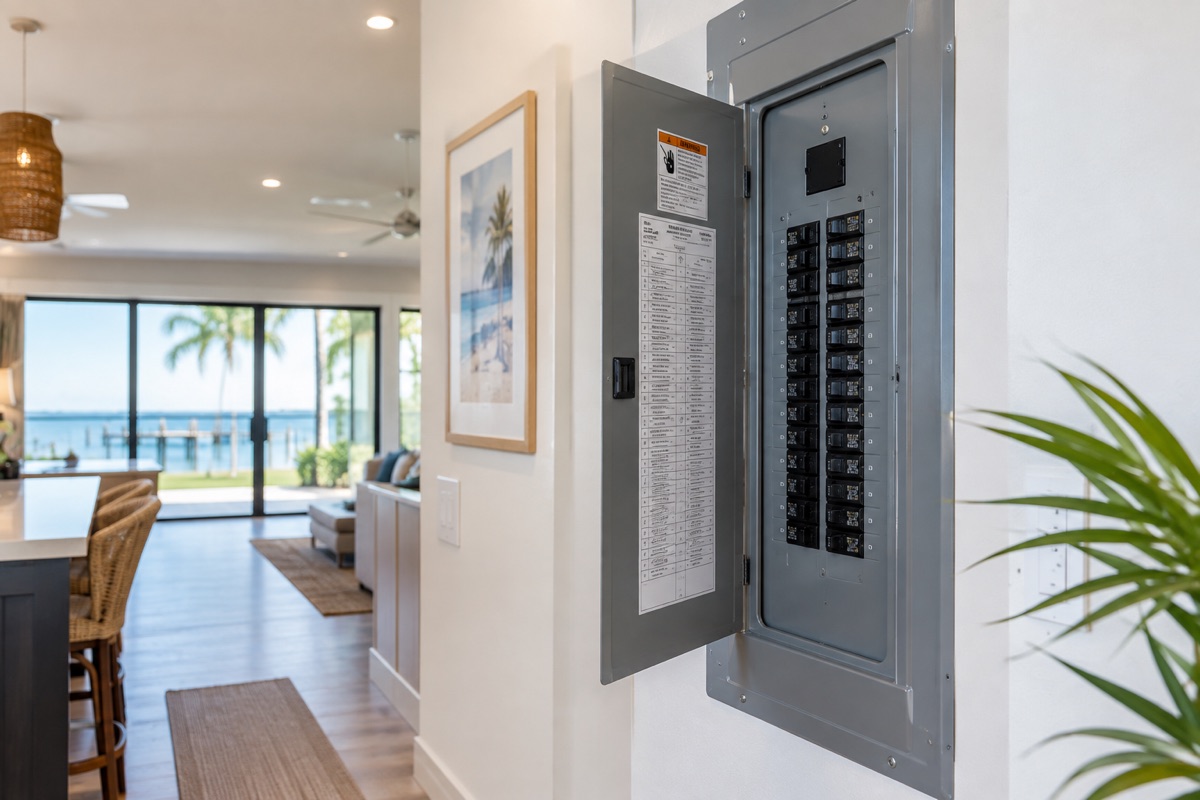
Your electrical panel is one of the most important pieces of equipment in your home, and it’s one most people only think about when a breaker trips. In Jacksonville, that panel works harder than in most of the country. Our air conditioners run most of the year, afternoon thunderstorms roll through almost daily in summer, and homes near the beaches deal with salt air that wears on anything metal.
This guide covers what’s inside your panel, the different types of breakers and when each one makes sense, the newer “smart” options, whole-home surge protection, and why your panel and meter benefit from a check-up every few years.
A quick safety note: Everything below is meant to help you understand your system and have better conversations with your electrician. The inside of a panel is live even with the main breaker off. Please leave the cover on and call a licensed electrician for any work inside it.
What Your Panel Actually Does
Power comes from the utility lines, passes through the meter on the outside of your house, and enters your main panel (also called a load center or breaker box). From there it’s split into individual circuits, and each circuit is protected by a breaker.
A breaker has one core job: shut off power when a circuit is carrying more current than its wiring can safely handle. Too much current means heat, and heat in a wall is how electrical fires start. Everything else a breaker does, from GFCI to arc fault to smart monitoring, is added on top of that basic job.
Types of Breakers
Standard Breakers: Single Pole and Double Pole
Standard breakers (sometimes called thermal-magnetic breakers) protect against two things:
- Overloads, like too many space heaters on one circuit. The breaker heats up internally and trips after a short delay.
- Short circuits, where a hot wire touches a neutral or ground. The breaker trips almost instantly.
They come in two main configurations:
Single pole breakers occupy one slot in the panel and supply 120 volts. They power most of your home: lighting, standard outlets, fans, garage door openers, and small appliances. The most common sizes are 15 and 20 amps.
Double pole breakers occupy two slots and supply 240 volts. They serve the big loads:
- Central air conditioner and heat pump
- Electric water heater
- Electric dryer and range
- Pool and spa pumps (a big one in Jacksonville)
- EV chargers
If you’ve ever noticed a wide breaker with a handle tied across two slots, that’s a double pole. Both halves trip together so a 240-volt appliance never ends up half energized.
GFCI Breakers: Protecting People from Shock
A Ground Fault Circuit Interrupter (GFCI) watches the current leaving on the hot wire and returning on the neutral. Those two numbers should match. If even a few thousandths of an amp go missing, that current is leaking somewhere it shouldn’t, possibly through a person, and the GFCI shuts off in a fraction of a second.
GFCI protection is required in areas where water and electricity are close together, including:
- Bathrooms and kitchens
- Laundry areas
- Garages and unfinished spaces
- Outdoor outlets
- Pools, spas, and hot tubs
You can get GFCI protection from a GFCI outlet (the one with “Test” and “Reset” buttons) or a GFCI breaker in the panel. A breaker protects the entire circuit from one place, which is a good choice for pool equipment, outdoor circuits, and places where an outlet would be awkward to reach or exposed to weather.
Jacksonville angle: Between pools, lanais, outdoor kitchens, and our humidity, outdoor GFCI protection gets tested here constantly. If an outdoor GFCI trips after a heavy storm, it’s often moisture in an outlet box or a weather cover that isn’t sealing. That’s the device doing its job, but it’s also a sign something needs attention.
Arc Fault (AFCI) Breakers: When They Help, and When They’re a Headache
An Arc Fault Circuit Interrupter (AFCI) listens for the electrical signature of arcing: small sparks jumping across a damaged wire, a loose connection, or a nail driven through a cable. Arcing can smolder inside a wall for a long time before becoming a fire, and a standard breaker won’t notice it because it doesn’t necessarily draw extra current.
Where AFCIs are a real benefit:
- Older homes, where insulation has aged and connections have loosened over decades
- Bedrooms and living areas, where cords get pinched behind furniture or run under rugs
- Homes that have been renovated by different people over the years, with splices and connections of unknown quality
- Anywhere a wire could be damaged by a picture nail, a TV mount, or a pest
Current code requires AFCI protection on most living-area circuits in new construction and in many renovations.
When they can be more trouble than they’re worth:
AFCIs are good at their job, but they’re not perfect, and they have a reputation for “nuisance tripping.” Common culprits include:
- Older motors and appliances: some vacuums, treadmills, window units, and power tools produce electrical noise that can look like an arc
- Shared neutrals in older wiring, which are common in homes built before AFCIs existed and can cause constant tripping
- Certain dimmers, LED drivers, and electronics that don’t play well with arc detection
- Early-generation AFCI breakers, which were more sensitive than today’s models
Our honest take: a frequently tripping AFCI isn’t automatically a bad breaker. Sometimes it’s catching a real wiring problem. Sometimes it’s an incompatible appliance. Sometimes the breaker is simply outdated. The fix might be updating firmware or the breaker itself, correcting a shared neutral, or moving an appliance to a different circuit. What we don’t recommend is swapping it for a standard breaker to make the problem go away, which may also put you out of code compliance. If a breaker in your home won’t stay reset, our electrical troubleshooting starts with finding out why.
Dual function breakers combine AFCI and GFCI protection in one breaker. They’re common in kitchens and laundry rooms, where both are now required.
Smart Breakers: Your Panel as an Early Warning System
This is where panels have changed the most in recent years. Smart breakers (and smart panels) measure the power each circuit uses in real time and connect to an app on your phone. Several major manufacturers now offer them, and whole smart panels are available as well.
What that gets you:
- Circuit-by-circuit energy use, so you can see what’s actually driving your JEA bill
- Remote on/off control, handy for turning off a pool pump or water heater while you’re traveling
- Trip alerts, so you know a circuit went down even if you’re not home
- Load management for EV chargers, solar, and battery backup
The most useful benefit is catching equipment problems early.
Real-world example: your AC compressor. An air conditioning compressor that’s starting to wear out, or fighting a weak capacitor, low refrigerant, or a dirty condenser coil, will usually start drawing more current than normal before it fails. A smart breaker tracks that circuit every day, so it can flag the change:
- “Your AC circuit is drawing noticeably more than its usual baseline.”
- “Your AC is cycling on and off much more often than normal.”
Catching that early can mean the difference between replacing a capacitor or contactor and replacing a compressor or an entire system. In Jacksonville, where an AC failure in August is an emergency and not an inconvenience, that warning is valuable.
The same idea works for well pumps, pool pumps, water heaters, and refrigerators.
Things to know before you buy:
- Smart breakers usually need to match your panel’s brand. Not every panel can accept them.
- If your panel isn’t compatible, a clamp-on energy monitor installed inside the panel can give you much of the same insight without replacing breakers.
- A smart panel makes the most sense when you’re already upgrading, such as adding an EV charger, solar, a generator, or a battery.
Did You Know? Whole-Home Surge Protection
Most people have a surge strip behind the TV. Far fewer know you can protect the entire house from the panel.
How It Works
A whole-home surge protective device (SPD) installs in or right next to your main panel. Under normal conditions, it does nothing. When voltage spikes, it reacts in a tiny fraction of a second and diverts the excess energy to your home’s grounding system, so it doesn’t travel through your circuits and into your electronics.
There are two common types:
- Type 1 installs on the utility side of the main breaker and handles large surges coming in from outside.
- Type 2 installs on the load side, usually inside the panel on a dedicated breaker. This is the most common residential installation.
Why It Matters in Jacksonville
Florida sees more lightning than almost anywhere in the country, and Northeast Florida gets its full share during our summer storm season. A strike doesn’t have to hit your house to cause damage. A strike nearby, on a power line, or on the utility equipment in your neighborhood can send a surge into dozens of homes at once.
Lightning isn’t the only source, either. Surges also come from:
- The grid switching and power being restored after an outage, which happens a lot during tropical storms and hurricanes
- Large motors inside your own home, such as your AC compressor and pool pump, starting and stopping many times a day
Those smaller internal surges don’t cause dramatic failures. They slowly wear down the electronics in everything from your TV to the control boards in your AC, washer, refrigerator, and garage door opener.
What Whole-Home Surge Protection Can and Can’t Do
- ✅ Protects hardwired equipment that a plug-in strip can’t reach: AC and heat pump control boards, water heaters, pool equipment, smart thermostats, ceiling fans, and built-in appliances
- ✅ Provides a strong first layer of protection for the whole house
- ✅ Is now required by code on new and replaced residential services
- ❌ Won’t stop a direct lightning strike on your home (nothing realistically will)
- ❌ Doesn’t replace point-of-use protection for sensitive electronics. The best approach is layered: a whole-home device at the panel plus quality surge strips for computers and TVs.
- ❌ Isn’t permanent. Surge protectors wear out as they absorb surges. Most have an indicator light, and it’s worth checking after big storm seasons.
A whole-home surge protector depends on a good grounding system. If your grounding is old, corroded, or incomplete, the device can’t do its job, which leads to the next topic.
Your Panel and Meter Need Maintenance Too
Most homeowners never think about the gray box on the outside wall or the panel in the garage until something goes wrong. But both have connections that change over time, and a bit of periodic service can prevent problems.
Why Connections Loosen
Every time your AC kicks on, the wires feeding your home carry more current and warm up. When it shuts off, they cool down. That heating and cooling happens thousands of times a year, and in Jacksonville the AC runs most months of the year.
Over time, that thermal cycling causes connections to gradually loosen. This is especially true with aluminum conductors, which are commonly used for service entrance wiring and expand and contract more than copper.
A loose connection creates resistance, and resistance creates heat. That heat loosens the connection further, which creates more heat. Left alone, this can lead to:
- Flickering or dimming lights, especially when big appliances start
- Breakers that feel warm or trip for no obvious reason
- Scorched or melted breakers, bus bars, or meter base jaws
- Damage to appliances from unstable voltage
- In the worst cases, a fire
What a Panel and Meter Service Includes
A professional panel check-up typically includes:
- Re-torquing connections to the manufacturer’s specifications with a calibrated torque tool. Code now calls for this, and “hand tight” isn’t good enough.
- Thermal (infrared) scanning to find hot spots that aren’t visible to the eye
- Inspecting the meter base for corrosion, heat damage, or worn jaws
- Checking the grounding and bonding, which is critical for surge protection and safety
- Looking for signs of moisture, pests, or corrosion inside the panel
- Checking labeling so you know which breaker controls what
Work on the meter base usually requires coordinating with JEA, since the meter itself belongs to the utility. The meter base and everything on your side of it are the homeowner’s responsibility. A licensed electrician handles that coordination for you.
The Benefits
- Fewer surprises: find a failing connection before it fails
- Longer equipment life for your panel and the appliances connected to it
- Lower fire risk
- Better-performing surge protection because of solid grounding
- Peace of mind before hurricane season, when you want your system in its best shape
Jacksonville-Specific Things We Watch For
- Salt air at the beaches. Homes in Jacksonville Beach, Neptune Beach, Atlantic Beach, and Ponte Vedra see faster corrosion on outdoor meter bases, panels, and disconnects. A yearly look is smart if you live near the ocean.
- Humidity and garage panels. Many Jacksonville panels are in garages that stay warm and humid, which can speed up corrosion over time.
- Older panels in established neighborhoods. Homes built from the 1960s through the 1980s, common in areas like Arlington, Mandarin, the Westside, and parts of the Southside, sometimes still have panels from manufacturers such as Federal Pacific (Stab-Lok) and Zinsco. These brands have well-documented reliability concerns. If you have one, it’s worth having it evaluated, and we replace Federal Pacific and Zinsco panels throughout Jacksonville.
- After a flood. If water ever reached your panel, including during events like Hurricane Irma’s flooding in 2017, the breakers and often the panel itself need to be replaced. Water-exposed breakers aren’t safe to keep using, even if they seem to work.
How Often Should You Have Your Panel Checked?
A good rule of thumb:
- Every 3 to 5 years for a typical home in good condition
- Every year for homes near the coast, older panels, or homes with heavy loads like pools, EV chargers, or workshops
- Right away if you notice flickering lights, warm or buzzing breakers, a burning smell, scorch marks, or breakers that won’t stay reset
The Bottom Line
Your panel does more than hold a row of switches. The right breakers keep your family safe from shock and fire, smart breakers can warn you about a failing AC before it leaves you sweating in August, whole-home surge protection defends against Florida’s storms, and periodic maintenance keeps the whole system reliable for years.
This article is for general information. Electrical codes and requirements vary by jurisdiction and change over time. Always consult a licensed electrician before doing any electrical work.
Frequently asked questions
What's the difference between a GFCI and an AFCI breaker?
A GFCI protects people from shock by shutting off when current leaks out of the circuit, such as through a person. An AFCI protects against fire by detecting the electrical signature of arcing from damaged wires or loose connections. Dual function breakers do both.
Why does my AFCI breaker keep tripping?
It may be catching a real wiring problem, reacting to electrical noise from an older motor or appliance, tripping on a shared neutral in older wiring, or simply be an early-generation breaker. An electrician can find the cause; replacing it with a standard breaker isn't recommended and may put you out of code compliance.
Do I need whole-home surge protection in Jacksonville?
Florida sees more lightning than almost anywhere in the country, and surges also come from grid switching and your own A/C and pool pump. A whole-home surge protector is now required by code on new and replaced residential services, and it protects hardwired equipment that plug-in strips can't.
How often should I have my electrical panel checked?
Every 3 to 5 years for a typical home in good condition, every year for homes near the coast, older panels, or homes with heavy loads like pools, EV chargers, or workshops, and right away if you notice warning signs like flickering lights, warm or buzzing breakers, or a burning smell.