

A/C
The Magic of Heat Pumps: Why Every Home Should Consider One (Yes, Even in Florida)
How a heat pump cools and heats your home with one system, how it works under the hood, why it suits Jacksonville's climate, and how the energy savings add up.
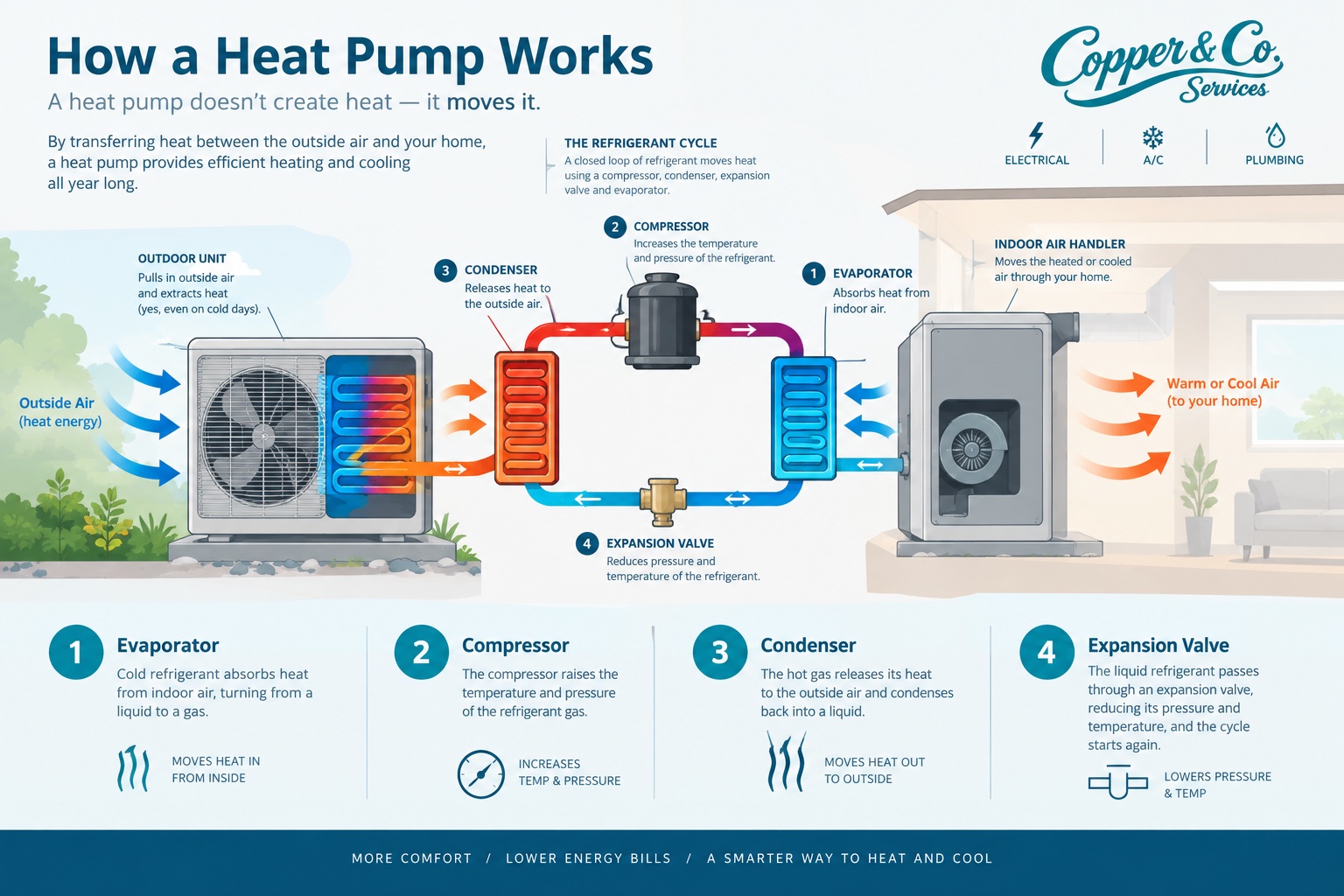
Here’s a trick that sounds too good to be true: a machine that puts two to three units of heat into your home for every one unit of electricity it uses. No flame, no fuel delivery, no glowing coils. Just physics.
That machine is a heat pump, and there’s a good chance one is already sitting outside a house on your street. In Jacksonville, where we run our air conditioning most of the year but still get real cold snaps between December and February, a heat pump is often the smartest system you can put in your home.
This guide starts simple, gets into the engineering for those who want it, and ends with a real-world look at the energy savings and how payback works.
The Short Version: What Is a Heat Pump?
A heat pump is an air conditioner that can run in reverse.
- In summer, it pulls heat out of your house and dumps it outside, exactly like a standard AC.
- In winter, it pulls heat out of the outdoor air and moves it inside.
“But wait,” you might say, “there’s no heat in 40-degree air.” There actually is quite a lot. Anything above absolute zero (about −460°F) contains heat energy. A heat pump doesn’t create heat. It moves heat that’s already there, and moving heat takes far less energy than making it.
That’s the magic. Your refrigerator does the same thing every second of the day, pulling heat out of your food and releasing it into your kitchen.
How Most Jacksonville Homes Heat Today
Many homes in Northeast Florida, especially those built from the 1970s through the early 2000s, have a straight-cool AC with electric heat strips in the air handler. When it’s cold, the system turns on what are essentially large toaster elements and blows air across them.
Heat strips are simple and reliable, but they’re the most expensive way to heat with electricity. Every kilowatt-hour you pay for becomes exactly one kilowatt-hour of heat. A heat pump turns that same kilowatt-hour into two to three or more.
If you’ve ever opened a January JEA bill and wondered why it rivaled August, heat strips are usually the reason.
Why Heat Pumps Make So Much Sense in Florida
There’s a common belief that heat pumps are for cold climates, or that Florida doesn’t need heat. Neither holds up.
Our winters are a heat pump’s sweet spot. Heat pumps are most efficient when the outdoor air is mild. Jacksonville winters are mostly cool rather than frigid. January nights often drop into the 40s and occasionally below freezing, but sustained deep cold is rare. That means a heat pump handles almost all of our heating hours at high efficiency, with backup heat only on the coldest mornings.
We need heat more than people think. From roughly December through February, plus scattered cool mornings in November and March, most Jacksonville homes run the heat. That’s several months of heating bills.
It’s the same equipment you’d buy anyway. A heat pump replaces your outdoor AC unit with an outdoor unit that can also heat. You still need cooling, so you’re buying an outdoor unit either way. The heat pump version typically costs only modestly more.
One system, year-round. No separate furnace, no gas line, no combustion, and no carbon monoxide risk from your heating system.
Under the Hood: How a Heat Pump Actually Works
For those who want the engineering, here’s what’s happening inside.
The Refrigeration Cycle
Every heat pump and air conditioner uses the same four-step cycle built around a refrigerant, a fluid chosen because it boils and condenses at useful temperatures and pressures.
- Evaporation (absorbs heat). Low-pressure liquid refrigerant flows through a coil. Because its boiling point at that pressure is very low, it boils even when the surrounding air is cool, and boiling absorbs a large amount of heat from that air.
- Compression (adds pressure and temperature). The compressor squeezes the now-gaseous refrigerant. Compressing a gas raises its temperature, so refrigerant that left the coil at, say, 30°F can leave the compressor well above 100°F.
- Condensation (releases heat). The hot, high-pressure gas flows through a second coil. Because it’s hotter than the air around that coil, it gives up its heat and condenses back into a liquid.
- Expansion (drops the pressure). The liquid passes through an expansion valve, which drops its pressure and temperature, and the cycle starts again.
The compressor is the only part doing serious work, and its job isn’t making heat. It’s raising the refrigerant’s temperature enough that heat flows “downhill” where we want it to go.
The Reversing Valve: The Part That Makes It a Heat Pump
A standard AC always runs that cycle in one direction: absorb heat at the indoor coil, release it at the outdoor coil.
A heat pump adds a reversing valve, a four-way valve that switches the direction refrigerant flows. Flip it, and the indoor coil becomes the hot condenser while the outdoor coil becomes the cold evaporator. The same hardware now heats your home.
Measuring Efficiency: COP, SEER2, and HSPF2
Coefficient of Performance (COP) is the simplest measure. It’s the heat delivered divided by the electricity used.
| Heating method | Typical COP | Heat delivered per kWh of electricity |
|---|---|---|
| Electric heat strips | 1.0 | 1 kWh |
| Heat pump at 47°F outdoors | Often 3.0–4.0+ | 3–4 kWh |
| Heat pump at 17°F outdoors | Often 1.8–2.5 | ~2 kWh |
Efficiency drops as it gets colder because the heat pump has to “lift” heat across a bigger temperature difference. Jacksonville spends very few hours in that colder range.
SEER2 measures cooling efficiency over a season, and HSPF2 measures heating efficiency over a season. Higher is better for both. These “2” ratings replaced the older SEER and HSPF in 2023 using a test that better reflects real duct conditions, so the numbers look a little lower than the old ratings for the same performance. If you’re comparing an older system rated “SEER 10” with a new one rated “15.2 SEER2,” the new one is far more efficient than the raw numbers suggest.
Defrost Mode
When a heat pump heats in cold, damp weather, its outdoor coil runs below freezing and moisture from the air can frost onto it. Frost blocks airflow, so the system periodically runs a defrost cycle. It briefly switches to cooling mode to warm the outdoor coil and melt the frost, usually for a few minutes.
During defrost, you may see steam rising from the outdoor unit or hear a whoosh as the valve shifts. That’s normal. Modern systems use sensors to defrost only when it’s actually needed. (Seeing something that doesn’t look normal? Our guide to common A/C problems covers what to watch for.)
Backup (Auxiliary) Heat and the Balance Point
Every home has a balance point: the outdoor temperature at which the heat pump alone can just keep up with the home’s heat loss. Below that temperature, the system turns on its backup heat strips to help.
The goal of a good installation is to keep that balance point low so the strips rarely run. That comes down to correct sizing, good duct design, and thermostat settings that don’t call for backup heat unnecessarily. In Jacksonville, a properly sized and configured heat pump should lean on its strips only during our handful of truly cold mornings.
A common mistake: Large thermostat setbacks. If you drop the temperature to 62°F overnight and bump it to 70°F at 6 a.m., many thermostats will fire the heat strips to recover quickly, wiping out much of the savings. With a heat pump, steady settings or small, gradual setbacks usually work best.
Variable-Speed (Inverter) Heat Pumps
Older systems run at one speed, full blast, and cycle on and off. Today’s variable-speed or inverter heat pumps can ramp their compressor anywhere from a low simmer to full output.
What that means for Jacksonville homes:
- Better humidity control in summer. Long, low-speed runs pull far more moisture out of the air.
- Fewer temperature swings and quieter operation.
- Better cold-weather performance, which keeps the heat strips off longer.
- Higher seasonal efficiency across the board.
A Note on Refrigerants
New systems installed today use newer refrigerants such as R-454B or R-32, which have a much lower environmental impact than the R-410A they replace. Older systems still running on R-22 are the most expensive to repair, which often makes them the best candidates for replacement.
Common Myths
“Heat pumps don’t work when it’s cold.” Modern heat pumps keep heating well below freezing, and cold-climate models work in sub-zero temperatures. Jacksonville’s winters are well within a standard heat pump’s comfort zone.
“Heat pump air feels lukewarm.” Air from a heat pump is usually around 90 to 100°F at the vent, compared with hotter air from a gas furnace. It feels less “toasty” at the register, but it heats the home steadily and evenly. Variable-speed systems make this even less noticeable.
“They’re expensive.” In Florida, you need an outdoor AC unit regardless. The upgrade from a cooling-only unit to a heat pump is usually a modest added cost, and the heating savings pay it back, as the numbers below show.
“Heat pumps wear out faster because they run year-round.” Your Jacksonville AC already runs most of the year. Adding a few winter months to the outdoor unit doesn’t meaningfully shorten its life when it’s properly installed and maintained.
Who Should Consider a Heat Pump?
Short answer: nearly everyone replacing a system. It’s an especially strong fit if:
- You currently have an AC with electric heat strips
- Your system is 10 to 15 years old, uses R-22, or needs a major repair
- Your winter JEA bills are noticeably high
- You want better humidity control (choose variable-speed)
- You’re adding space, such as a bonus room, garage conversion, or addition, where a ductless heat pump (mini-split) can handle heating and cooling on its own
The Numbers: Energy Use, Savings, and Payback
Here’s a worked example for a typical Jacksonville home. These are estimates meant to show how the math works. Your actual numbers depend on your home’s size, insulation, ductwork, thermostat habits, and equipment.
Assumptions
- Home: About 2,000 sq ft, 3-ton system, ducts in the attic
- Electricity rate: A conservative $0.15 per kWh. JEA’s base rate alone is now a bit more than that before fuel charges, so your real savings are likely higher. We assume rates rise about 3% per year.
- Cooling: About 1,800 full-load cooling hours per year
- Heating: About 12 million BTU of heat needed per year, spread across Jacksonville’s winter months
- Old system: 10 SEER cooling with electric heat strips
- New AC option: 16 SEER-class cooling (about 15.2 SEER2) with electric heat strips
- New heat pump option: Same cooling efficiency, with an average heating COP of 2.5, a conservative figure for our climate
Estimated Annual Energy Use and Cost
| Old AC + heat strips | New AC + heat strips | New heat pump | |
|---|---|---|---|
| Cooling | ~6,480 kWh | ~4,050 kWh | ~4,050 kWh |
| Heating | ~3,520 kWh | ~3,520 kWh | ~1,410 kWh |
| Total HVAC energy | ~10,000 kWh | ~7,570 kWh | ~5,460 kWh |
| Annual HVAC electricity cost | ~$1,500 | ~$1,135 | ~$820 |
Two things stand out:
- Any new system saves money on cooling. Going from an old 10 SEER unit to modern equipment cuts cooling energy by more than a third.
- Only the heat pump also cuts heating costs. It uses roughly 60% less energy for heat than the strips do, worth about $315 per year in this example, on top of the cooling savings.
Scenario A: Your System Needs Replacing Anyway
This is the most common situation: the old system has failed, needs a major repair, or is near the end of its life. You’re buying a new outdoor unit either way, so the real question is whether the extra cost of choosing a heat pump over a cooling-only AC pays off.
| Heat pump vs. a new AC with heat strips | Estimated savings |
|---|---|
| First year | ~$317 |
| Over a 15-year system life (rates rising 3% a year) | ~$5,900 |
The quick math: divide the heat pump upgrade cost on your quote by about $317, and that’s roughly how many years it takes to pay for itself. Because the step up from a cooling-only unit to a heat pump is usually modest, payback typically comes within a few winters, and the savings keep coming for the rest of the system’s life.
For most Jacksonville homeowners replacing a system, choosing a heat pump is one of the best-returning decisions in the whole project.
Scenario B: Upgrading a Working but Inefficient System
Some homeowners consider replacing an older system that still runs, purely to save energy. Here, the comparison is the full installed cost of a new heat pump system against the old 10 SEER system with heat strips.
| New heat pump vs. the old system | Estimated savings |
|---|---|
| First year | ~$681 |
| Over a 15-year system life (rates rising 3% a year) | ~$12,700 |
Notice what moves payback here: the installed price. Energy savings are fixed by your home and the equipment. The price you pay is the variable you control, and the same savings pay back a lower-priced installation years sooner. That can be the difference between a system that pays for itself late in its life and one that pays for itself well within it.
Energy savings alone rarely justify replacing a healthy system, and we’ll tell you that. But when an older system needs a costly repair such as a compressor, a coil, or an R-22 recharge, adding that avoided repair cost to the equation often makes replacement the clear winner.
How Our Pricing Shortens Your Payback
This is where Copper & Co. makes a real difference. Our new system installations are priced well below what many homeowners are quoted elsewhere, and as the math above shows, every dollar saved up front comes straight off your payback period.
A lower installed price means:
- Payback measured in years, not decades, even on early upgrades
- More of the system’s 15-year life spent “in the black”
- Room in the budget for upgrades that compound the savings, like a variable-speed system, duct sealing, or a whole-home surge protector to protect your new equipment
Because we’re both an electrical and an HVAC company, we also handle the electrical side of your installation, including the disconnect, circuit sizing, breaker, and any panel work, without a second contractor and without a second markup.
What Can Change Your Numbers
- Home size and insulation: Larger or leakier homes use more energy, which means bigger savings.
- Thermostat habits: Avoiding large winter setbacks keeps heat strips off and savings high.
- Ductwork: Leaky attic ducts waste energy with any system. Sealing them adds to your savings.
- Equipment choice: A higher-efficiency, variable-speed heat pump saves more on both cooling and heating.
- Electricity rates: JEA adjusted its rates on October 1, 2026, and rates have generally trended upward over time. Higher rates mean faster payback.
The Bottom Line
A heat pump is one of the few home upgrades that improves comfort, efficiency, and safety at the same time. In Jacksonville, where you’ll own an outdoor unit no matter what, choosing a heat pump usually costs a little more up front and pays that back within a few winters, then keeps saving for the life of the system.
This article is for general information. The energy and savings figures are illustrative estimates based on the stated assumptions and are not a guarantee of results. Actual energy use, costs, and payback vary by home, equipment, usage, and utility rates.
Frequently asked questions
Can I add a heat pump to my existing air handler?
Sometimes, but it's usually best to replace the indoor and outdoor units as a matched system. Matched systems deliver their rated efficiency and are typically required for full manufacturer warranty coverage.
Will a heat pump keep my house warm on the coldest nights in Jacksonville?
Yes. On the few nights the heat pump can't keep up alone, the backup heat strips assist automatically.
Is a heat pump louder than a regular AC?
No. In cooling mode they're the same, and variable-speed heat pumps are often quieter than older single-stage units.
Do heat pumps need different maintenance?
Maintenance is very similar to an AC. Because the system runs in both seasons, an annual check-up becomes even more valuable.
What about ductless heat pumps?
Ductless mini-splits are heat pumps without ducts, ideal for additions, garages, sunrooms, and problem rooms that never stay comfortable.
Do heat pumps work with smart thermostats?
Yes, but the thermostat must be configured for a heat pump so it controls the reversing valve and backup heat correctly. We set that up as part of the installation.